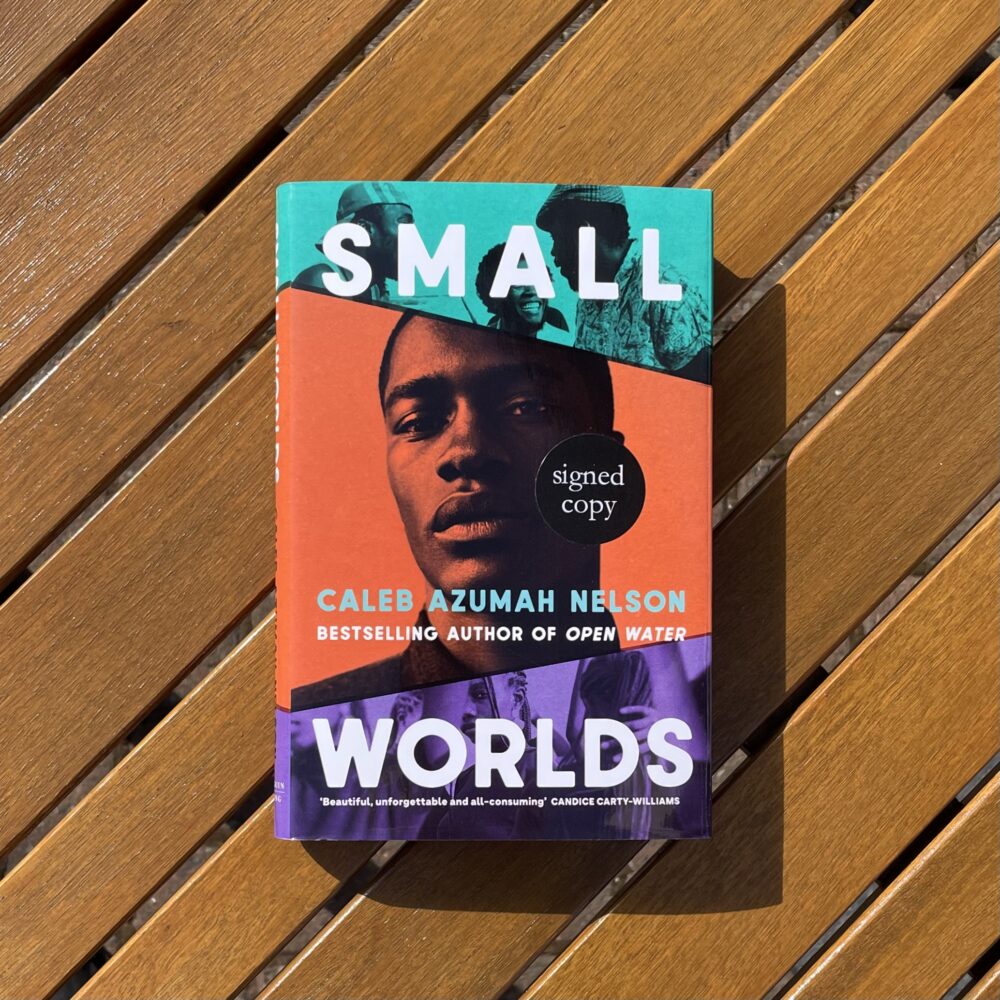
“Because while grief is never over, we find a way to walk in the light someone has left behind”
There is a quiet ache that runs through Caleb Azumah’s Small Worlds, It doesn’t announce itself. Instead, it flows quietly, slowly etching itself with each character, silence, gasp of air, music, memory and half fulfilled desire. The writer doesn’t focus on dramatic conflicts but instead sheds light on the emotional aftershock that comes with being displaced, losing faith; the feeling of loss and grief alongside becoming. Each character moving in their small world with a sense of restraint, holding on to histories that make them who they are now, and what they would be in future.
A way to understand the emotional landscape used by the author is through the concept of “extalgia;” a forward facing longing which is shaped by memory. Extalgia is the direct opposite of Nostalgia which longs for the past. Extalgia longs for the future, haunted by what has been deferred or imagined. It is a yearning for a version that has been unburdened, whole and free.
In Small Worlds, extalgia makes itself known in the form of the unfinished self; a self that is constantly evolving, constantly in the process of becoming but never fully resolved. Be it through the careful unfolding of queer desires, or the lingering presence of faith, the characters are constantly kept in a state of emotional suspense. This article discusses extalgia in Small Worlds not just as a thematic concern but as a structuring emotional condition that shapes identity itself, thereby showing how the self perpetually remains unfinished in the face of memory, longing and modern diasporic life.
The author portrays home not just as a place, but as the people. Stephen’s sense of self being perpetually tied not just to his neighborhood, but to the people who make up this neighbourhood; Auntie Yaa, Uncle T, Del, Kwame, amidst others, the familiarity bred from a wave across the street, the friends made through other friends from kicking ball around. Place itself is never neutral, London and Ghana function more as emotional terrains shaped by longing and memories rather than mere geographical locations. Here movement does not guarantee belonging and neither does return promise resolution. This is seen in the growth of the gap each time Stephen’s parents return to Ghana “must be a strange feeling, that this place my parents have longed for, a place they used to call home, could also reject them in their current form, could ask them to be someone else (47).
London is portrayed as a place of survival, gradual self-development rather than emotional completion, it is where the characters study, build friendships, bonds, businesses, work, and love but yet this movement seems stagnant, a constant movement in the same position. While becoming is allowed, settling is not permitted. This partial belonging mirrors the characters interior states, while they are thriving, present and active, they are all emotionally guarded, as though afraid to open up a can of worms. Extalgia sharpens this tension as the future London holds is continuously interrupted with memories that pull the self elsewhere.
Ghana on the other hand is portrayed more as a place of memory and emotional reference than a place to return to. It is often called upon in memories, music, food and faith not as a destination for displacement. It is instead an anchor to what once was, an everlasting reminder to what was, and what could have been, an earlier sense of self. Ghana represents what was once whole and pure, the characters do not merely wish to return, they want all what Ghana signifies which is the love, connection, togetherness, familiarity and sense of self that existed before fragmentation. As a result of this, home in Small Worlds, exists more as an idea rather than a place. Neither London nor Ghana suffices fully as home, thereby making the characters movements seem more circular than progressive. Here, movement does not clarify identity, instead it complicates it, the characters inhabit locations that mirror their inner states.
Extalgia in Small Worlds does not merely discuss how characters relate to space, but it also shows how said characters experience identity themselves. The self in the novel is never fully settled, but instead hangs in perpetual suspension. Queer desire here is fueled by hesitation, unfolding softly, shaped by silence rather than declaration as seen in Stephen and Del’s relationship. Stephen’s relationship with his father also hangs on this queer desire; he wishes for something similiar between Ray and his father, but instead, silence is mirrored between both parties. Extalgia deepens this restraint by producing a longing for the image of a finished self; the characters not only desire themselves, but also desire a completeness of self that seems far out of reach. Extalgia encourages them to imagine who they could have been under different circumstances, even as they struggle to fully inhabit who they are becoming. The self remains suspended between memory and possibility, never quite arriving.
One of the most striking features of Small Worlds is its reliance on silence and restraint as narrative strategies. Much of what the characters feel remains unspoken. Conversations trail off, emotions are internalized, and meaning is often conveyed through what is withheld rather than what is said. Extalgia plays a crucial role here, encouraging inward reflection over outward expression. The characters are deeply attuned to their emotional worlds, yet hesitant to externalize them. They are constantly assessing, remembering, and imagining, but rarely declaring. This creates a pattern of emotional containment that mirrors their broader struggles with identity and belonging. “I want to say, I left university because solitude became loneliness; this loneliness became oppressive. The sadness of it pressing down like two hands on my shoulders. I want to say, I felt so unwanted, I didn’t want to be with myself.”(139) Stephen continuously has feelings which are difficult to explain to everyone and sometimes even himself. The self, therefore, remains cautious and incomplete not because it lacks depth, but because it is shaped by restraint. In Small Worlds, becoming is a slow, fragile process. Identity is not resolved through confession or confrontation, but lived quietly, imperfectly, and over time.
The most significant impact of extalgia in Small Worlds is the way it holds the characters in a state of anticipation. Rather than propelling them confidently toward the future, extalgia keeps them waiting for it emotionally preparing, imagining, and rehearsing lives that never fully arrive. The future exists not as a space of action, but as a promise continually deferred. This anticipation becomes a mode of living, shaping how the characters relate to time, desire, and growth. This makes Small Worlds feel as though it is in an emotional limbo, moments that are meant to signify emotional growth are often met with skepticism as seen in Stephen’s relationship with Annie, he refuses to give the relationship a name and instead watches how whatever it is between them grows and eventually fades. In presenting extalgia this way, Small Worlds offers a nuanced account of contemporary diasporic and queer experience one where longing does not lead neatly to self-discovery, and waiting does not guarantee arrival. The impact of extalgia, then, lies not in dramatic loss or overt tragedy, but in the slow erosion of emotional momentum. The characters continue living, loving, and becoming, but always under the quiet weight of a future that feels just out of reach.
What emerges most clearly is the figure of the unfinished self: a self that is not broken, but cautious; not stagnant, but slow. The characters are not failing to arrive at themselves — they are learning how to live while still becoming. Extalgia, in this sense, is not simply a condition of loss, but a reminder of how deeply the past remains woven into the future. It explains why growth in Small Worlds is uneven, why belonging feels partial, and why desire so often hesitates before it speaks.
Importantly, the novel does not romanticize this state of suspension. Extalgia is shown to be tiring, emotionally demanding, and at times isolating. Yet, Nelson treats this exhaustion with care rather than judgment. The characters’ restraint is not framed as weakness, but as a response to complexity, a way of surviving lives shaped by displacement, inherited faith, and fragile hope.
In presenting extalgia as a quiet but powerful force, Small Worlds invites readers to reconsider what it means to be whole. Perhaps completeness is not found in arrival, resolution, or certainty, but in the willingness to keep moving forward despite unfinishedness. The novel suggests that there is dignity in becoming slowly, and meaning in learning how to live even when the future feels just beyond reach.
Thank you for reading my article, and since you’ve come this far, let me introduce you to my favorite quotes from the book.
1. “All my dance moves my father’s, and his fathers before that, because the dead never leave. They’re in the slink of our hips, the swing of our limbs, in our whispers, our screams, our ecstasy.”
2. “You’ll take the guitar, but you’ll send for the records, it’ll be too expensive to take everything in one go. You pack your warmest clothes, fearing the cold might touch your bones. You try to stuff your life into a case which couldn’t possibly hold it. You try to wonder what your new life will look like, how you might go out into the vastness of the world, but all you can think of is the shape of the thing between you and joy. You hope that the distance and time haven’t warped and shifted it beyond recognition; you hope that your rhythm remains, that you might still be able to get into a car and drive with no destination.”
3. “The fall is easy. The ground is always close. You’re late paying your rent by a few days; the next month, by a week. You tell your landlord times are hard. He says holding the keys to his multiple properties, ‘Times are hard for all of us’.
- “Anger is just love in another body’“
- “Don’t be scared of being honest, being yourself. Or else you’ll end up like me.”